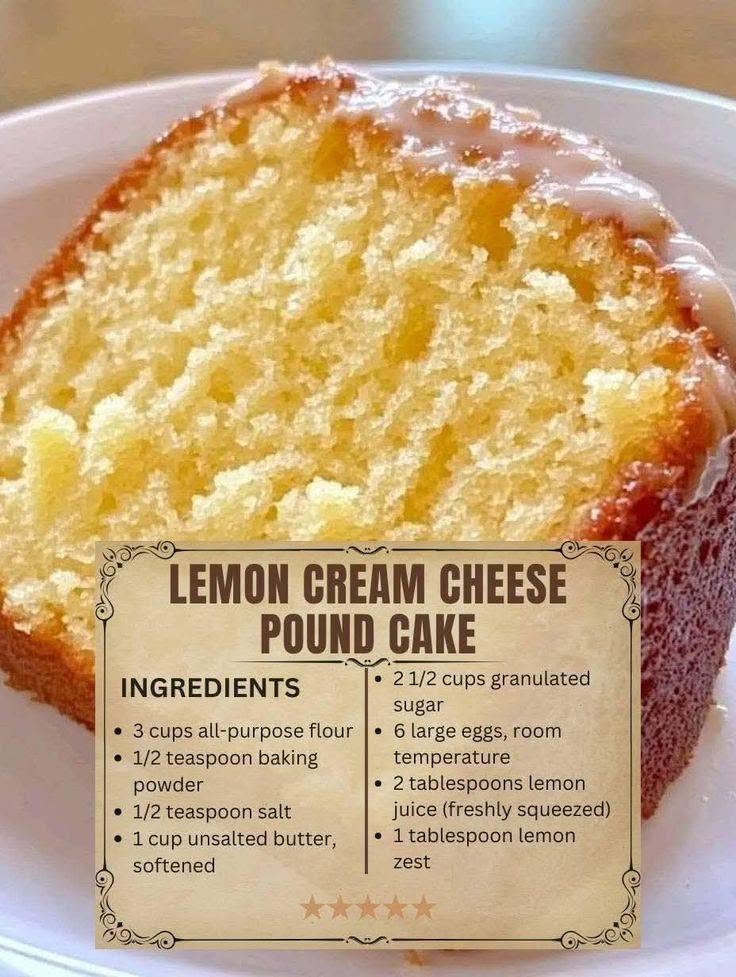
Lemon Cream Cheese Pound Cake

Instructions
Preheat your oven to 325°F (165°C).
A slightly lower oven temperature helps the pound cake bake evenly and develop its characteristic dense, tender texture without becoming overly dark on the outside before the center is finished.
Step 2: Prepare the Bundt Pan
Generously grease a 10- to 12-cup Bundt pan with softened butter or baking spray.
Dust the inside lightly with flour, making sure to coat the ridges and center tube thoroughly.
Tap out any excess flour.
Properly preparing the Bundt pan is especially important because the cake is rich and moist and needs to release cleanly after baking.
Step 3: Prepare the Lemon
Wash and dry the lemons thoroughly.
Finely grate the yellow outer layer of the lemon to create fresh lemon zest.
Avoid grating too deeply into the white pith underneath because it can have a bitter taste.
Juice the lemons and strain out any seeds.
Fresh lemon zest and juice provide the best flavor for this Lemon Cream Cheese Pound Cake.
Step 4: Combine the Dry Ingredients
In a medium bowl, whisk together the all-purpose flour, baking powder, and salt.
Mix until evenly distributed.
Set the dry ingredients aside.
Step 5: Cream the Butter and Cream Cheese
Place the softened butter and cream cheese in a large mixing bowl.
Beat until smooth and creamy.
This usually takes approximately 2–3 minutes with an electric mixer.
Make sure there are no large lumps of cream cheese remaining.
Step 6: Add the Sugar
Gradually add the granulated sugar to the butter and cream cheese mixture.
Continue beating for approximately 3–5 minutes, until the mixture becomes lighter, creamy, and fluffy.
Properly creaming the butter, cream cheese, and sugar helps create a tender texture and contributes to the cake’s structure.
Step 7: Add the Eggs
Add the eggs one at a time.
Beat well after each addition, scraping down the sides of the bowl as necessary.
Adding the eggs gradually helps maintain a smooth batter.
If the mixture looks slightly curdled after adding the eggs, don’t worry. It will come together when the flour is added.
Step 8: Add Vanilla and Lemon
Add the vanilla extract, fresh lemon zest, and fresh lemon juice.
Mix until evenly incorporated.
The lemon zest is particularly important because it contains concentrated citrus oils that give the cake its beautiful lemon aroma.
Step 9: Add the Dry Ingredients
Gradually add the flour mixture to the wet ingredients.
Mix on low speed just until the flour disappears.
Do not overmix the batter.
Overmixing can develop too much gluten and make the pound cake tougher than desired.
Step 10: Transfer the Batter to the Bundt Pan
Pour the batter evenly into the prepared Bundt pan.
Use a spatula to gently smooth the surface.
Tap the pan lightly against the counter once or twice to remove any large air pockets.
Step 11: Bake
Place the Bundt pan in the preheated oven.
Bake for approximately 75–90 minutes, depending on your oven and the exact size of your pan.
Begin checking the cake around the 70-minute mark.
The cake is ready when a long wooden skewer or cake tester inserted into the thickest part comes out with a few moist crumbs but no wet batter.
The top should be golden brown and the cake should feel firm when lightly touched.
Step 12: Cool the Cake
Remove the cake from the oven and place the Bundt pan on a wire rack.
Allow the cake to cool in the pan for approximately 15–20 minutes.
Do not attempt to remove it immediately because the cake can be fragile while extremely hot.
Step 13: Release the Cake
Carefully loosen the edges of the cake with a thin spatula or butter knife if necessary.
Place a serving plate over the Bundt pan.
Invert the pan carefully and allow the cake to release onto the plate.
Let the cake cool completely before adding the glaze.
Step 14: Prepare the Lemon Glaze
In a small bowl, whisk together the powdered sugar and fresh lemon juice.
Add lemon juice gradually until the glaze reaches your desired consistency.
Add lemon zest for extra citrus flavor.
For a richer glaze, add a tablespoon of melted butter.
Step 15: Glaze the Cake
Once the cake is completely cooled, drizzle the lemon glaze slowly over the top.
Allow the glaze to naturally flow down the sides and into the ridges of the Bundt cake.
For a thicker glaze, use less lemon juice.
For a thinner drizzle, add a little more lemon juice.
Step 16: Garnish and Serve
Finish with fresh lemon zest, thin lemon slices, or fresh berries if desired.
Slice the cake using a sharp serrated knife and serve.
Notes
For the best Lemon Cream Cheese Pound Cake, make sure the butter, cream cheese, and eggs are at room temperature.
Room-temperature ingredients combine more easily and help create a smooth, uniform batter.
Do not overmix once the flour has been added. Mix only until the dry ingredients are incorporated.
Bundt pans vary considerably in shape and size, so baking time can vary. Start checking the cake toward the end of the recommended baking time rather than relying only on the clock.
The cake should be fully baked in the center before removing it from the oven.
Allow the cake to cool in the pan for approximately 15–20 minutes before turning it out. If you leave it in the pan too long, condensation can make the outside slightly damp; if you turn it out immediately, the cake may break.
Fresh lemon zest provides much more intense lemon aroma than lemon juice alone. For the strongest natural lemon flavor, use both zest and fresh juice.
Make sure you only zest the yellow outer skin of the lemon and avoid the white pith.
If the top of the cake becomes too dark before the center is finished, loosely tent it with aluminum foil during the final part of baking.
- Prep Time: 25 minutes
- Cook Time: 75–90 minutes
Nutrition
- Calories: 475
- Sodium: 250 mg
- Protein: 6 g